A 2026 study from Czech Technical University in Prague shows how AIRSKIN’s collision sensing capabilities make smarter, safer robot behavior possible
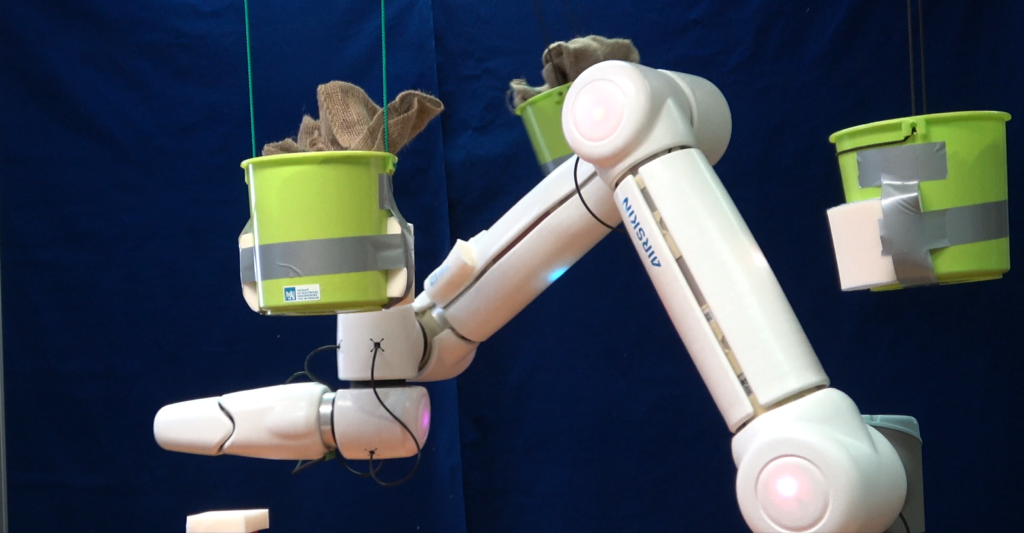
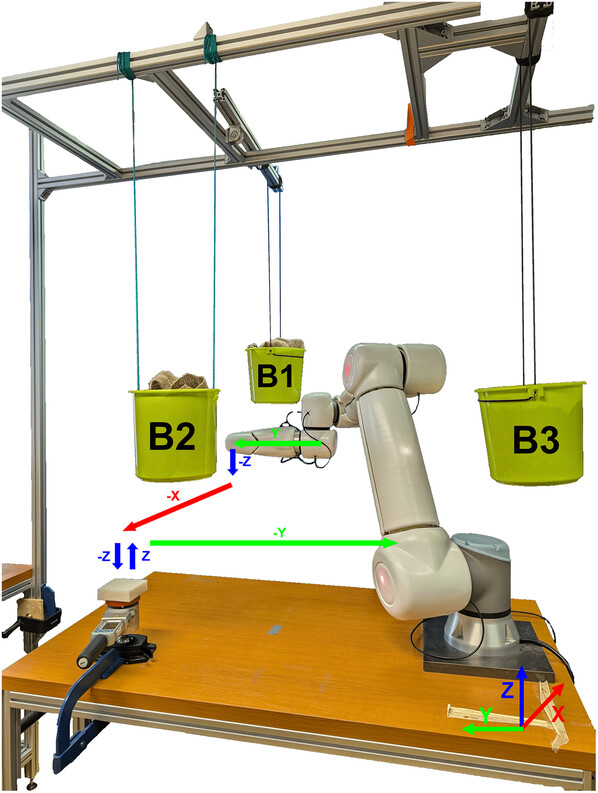
Testing a robot’s collision response usually doesn’t involve buckets of stones swinging from the ceiling, but that’s exactly how researchers at Czech Technical University in Prague spent part of their time for this study. It might sound like an unusual way to do robotics research, but it turned out to be an effective way to simulate real human-robot contact scenarios.
Behind the fun setup was a serious question: could robots be made smarter about when they actually need to stop after contact – without compromising operator safety?
The problem with fixed thresholds
Under Power and Force Limiting (PFL) regulations such as ISO 10218-2:2025, robots are allowed to make contact with human operators, as long as the resulting force stays within defined limits. But applying the same fixed stop-threshold across an entire robot’s surface means it often halts even when the actual impact force is well within safe limits, creating unnecessary interruptions and productivity losses.
Where AIRSKIN comes in
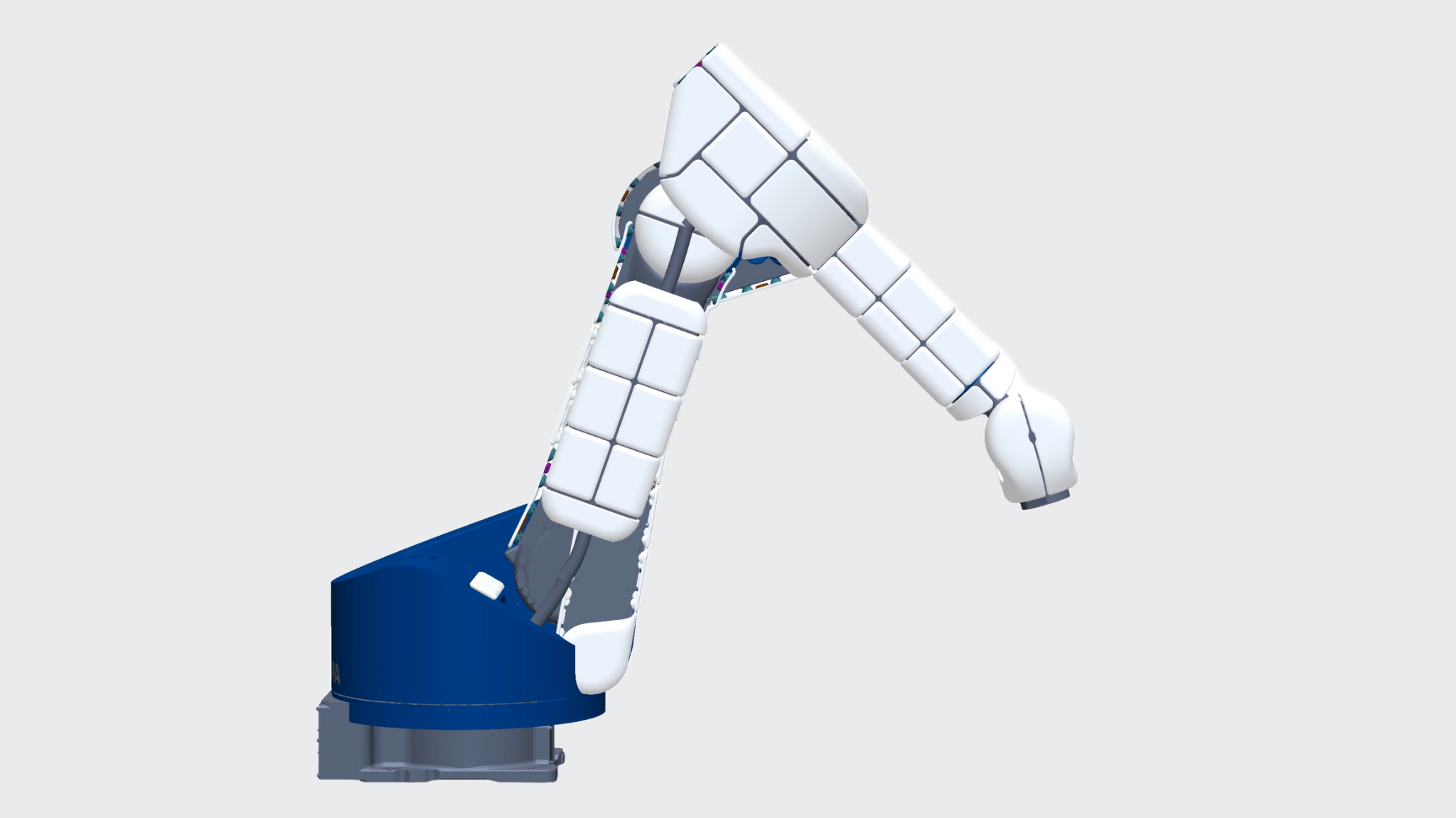
The researchers needed a way to not just detect contact, but isolate exactly where on the robot it happened – a prerequisite for calculating link-specific effective mass and estimating real impact force. AIRSKIN’s pad based design made this possible: its individually sensing pads (11 of them, covering the UR10e robot arm in this setup) let the team estimate collision force in real time – at a rate of 25 Hz – and decide instantly whether the robot should stop or keep working.
According to the researchers, this is the first study to adaptively set collision thresholds in a way that brings safety and productivity together under one framework. Until now, industry solutions like AIRSKIN have typically used the same fixed, highly sensitive threshold across all skin pads – reliable, but prone to unnecessary interruptions. This work shows what becomes possible when that sensing data is used more intelligently.
The results
Tested on a real UR10e robot equipped with AIRSKIN in a controlled environment, the adaptive approach:
– Increased task completion speed compared to the baseline
– Cut the number of robot stops
– Kept all measured impact forces conservative with respect to ISO 10218-2:2025 limits
The team validated their force estimates against real, physical measurements – confirming that the productivity gains didn’t come at the cost of operator safety in the used controlled environment.
A glimpse into the future of human-robot collaboration
What’s exciting about this research is what it hints at: the more precisely a robot can sense where and how hard it’s been touched, the smarter – and more human-aware – its behavior can become. Fixed safety thresholds are a good starting point, but adaptive, context-aware reactions might be where collaborative robotics is headed next.
It’s a small but telling example of how far human-robot collaboration has come and we’re glad AIRSKIN played a part in enabling this kind of research.
Study: “Adaptive Collision Sensitivity for Efficient and Safe Human-Robot Collaboration” by Lukas Rustler, Matěj Mísař and Matej Hoffmann, Czech Technical University in Prague, published in Advanced Intelligent Systems (Wiley).
https://advanced.onlinelibrary.wiley.com/doi/10.1002/aisy.70494